Pennsylvania Paycheck Calculator
Pennsylvania has a flat 3.07% state income tax. See your 2026 take-home pay after federal, state and FICA taxes.
You changed your inputs. Press Calculate to update your results.
Use this Pennsylvania paycheck calculator to estimate your 2026 take-home pay. Enter a salary or an hourly wage and see each deduction: federal income tax, Social Security, Medicare, Pennsylvania income tax and PA unemployment tax. Add your local Earned Income Tax rate for a full estimate, or use 3.735% for the Philadelphia wage tax (see below).
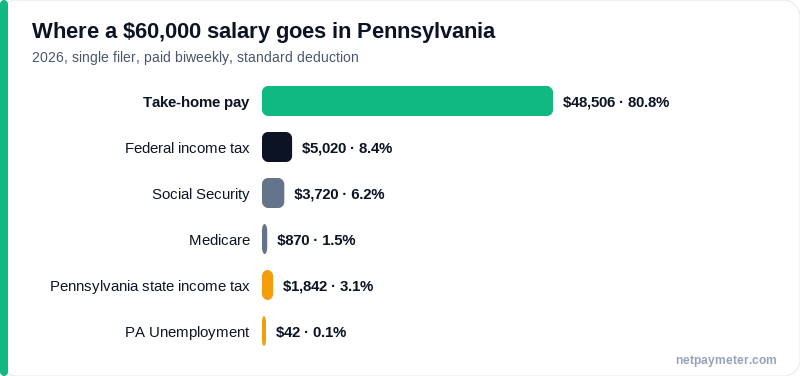
Quick answer: Pennsylvania taxes wages at a flat 3.07% with no standard deduction, and most towns add a local Earned Income Tax. A single filer earning $60,000 takes home about $48,506 a year, or $1,865.62 every two weeks, after $1,842 of Pennsylvania income tax and before any local tax.
How Pennsylvania taxes your paycheck
Pennsylvania's state income tax is simple: 3.07% of your wages, from the first dollar. There is no standard deduction and no personal exemption.
Pennsylvania differs from most states in two ways:
- Your 401(k) contributions are taxed. Most states let a pre-tax 401(k) lower your state taxable wages. Pennsylvania does not, so the 3.07% applies to the full salary.
- There is an employee unemployment tax. Workers pay 0.07% of wages for PA Unemployment Compensation (UC).
Then there is the local layer. Almost every Pennsylvania municipality charges a local Earned Income Tax (EIT), often about 1%. Philadelphia's wage tax is 3.735% for residents (3.425% for non-residents) since July 1, 2026. Many places also charge a Local Services Tax of up to $52 a year.
| Deduction | 2026 rate | Notes |
|---|---|---|
| Federal income tax | 10% – 37% | After the $16,100 standard deduction (single) |
| Social Security | 6.2% | Wages up to $184,500 |
| Medicare | 1.45% | +0.9% above $200,000 (single) |
| Pennsylvania income tax | 3.07% flat | No standard deduction; 401(k) is taxed |
| PA Unemployment (UC) | 0.07% | Of all wages |
| Local EIT | Varies | Often about 1%; Philadelphia 3.735% (residents) |
Worked example: $45,000 salary in Pennsylvania
A single filer earns $45,000 a year, is paid every two weeks (26 paychecks), has no pre-tax deductions and no local tax entered.
- Federal taxable income: $45,000 − $16,100 = $28,900
- Federal income tax: 10% × $12,400 = $1,240, plus 12% × $16,500 = $1,980. Total $3,220.
- Pennsylvania income tax: 3.07% × $45,000 = $1,381.50
- PA Unemployment: 0.07% × $45,000 = $31.50
- Social Security $2,790 and Medicare $652.50
| Item | Per paycheck (÷26) | Per month | Per year |
|---|---|---|---|
| Gross pay | $1,730.77 | $3,750.00 | $45,000.00 |
| Federal income tax | −$123.85 | −$268.33 | −$3,220.00 |
| Social Security | −$107.31 | −$232.50 | −$2,790.00 |
| Medicare | −$25.10 | −$54.38 | −$652.50 |
| Pennsylvania income tax | −$53.13 | −$115.13 | −$1,381.50 |
| PA Unemployment (UC) | −$1.21 | −$2.63 | −$31.50 |
| Take-home pay | $1,420.17 | $3,077.04 | $36,924.50 |
Amounts are rounded to the cent. This worker keeps about 82.1% of gross pay before local tax.
Adding your local Earned Income Tax
Local tax makes a real difference in Pennsylvania. If the same $45,000 worker lives in a town with a 1% EIT, enter 1 in the "Local income tax" box:
- Local EIT: 1% × $45,000 = $450 a year
- Take-home pay: $36,474.50 a year, or $1,402.87 every two weeks
Your rate depends on where you live and work, so check with your municipality or your employer's payroll team. The Local Services Tax, if your town charges it, is not included in the calculator.
Philadelphia paycheck calculator: the city wage tax
Philadelphia charges its own Wage Tax instead of the usual 1% EIT. The rates changed on July 1, 2026:
| Who pays | July 1, 2025 – June 30, 2026 | From July 1, 2026 |
|---|---|---|
| Philadelphia residents (wherever you work) | 3.74% | 3.735% |
| Non-residents who work in Philadelphia | 3.43% | 3.425% |
To estimate a Philadelphia paycheck, enter 3.735 (or 3.425 if you commute in) in the "Local income tax" box. On a $60,000 salary, single, paid every two weeks:
| No local tax | Philadelphia resident | Non-resident working in Philadelphia | |
|---|---|---|---|
| City wage tax | $0 | $2,241 | $2,055 |
| Take-home per year | $48,506 | $46,265 | $46,451 |
| Take-home every two weeks | $1,865.62 | $1,779.42 | $1,786.58 |
Lower-income workers who qualify for Pennsylvania tax forgiveness (PA-40 Schedule SP) can pay a reduced 1.5% rate and claim a refund of the difference from the city.
Pittsburgh and other Pennsylvania cities
Outside Philadelphia, your employer withholds the higher of your home town's resident EIT rate or your work location's non-resident rate (Act 32). Pittsburgh residents usually pay 3% (1% city plus 2% school district), and people who work in Pittsburgh but live elsewhere pay at least the 1% non-resident rate. Pittsburgh also charges the full $52 Local Services Tax ($2 per biweekly paycheck).
A Pittsburgh resident earning $60,000 (enter 3 in the local box) takes home about $46,706 a year, or $1,796.38 every two weeks, before the $52 Local Services Tax. The calculator doesn't include the Local Services Tax, so take $52 off the yearly figure. To find your exact rate, use the Pennsylvania DCED local tax lookup with your home and work addresses.
Pennsylvania salary after taxes (2026)
Single filer, paid every two weeks, no pre-tax deductions:
| Salary | PA income tax | Take-home (no local tax) | With a 1% local EIT |
|---|---|---|---|
| $40,000 | $1,228 | $33,064 | $32,664 |
| $50,000 | $1,535 | $40,785 | $40,285 |
| $60,000 | $1,842 | $48,506 | $47,906 |
| $75,000 | $2,302.50 | $59,237.50 | $58,487.50 |
| $100,000 | $3,070 | $76,040 | $75,040 |
| $150,000 | $4,605 | $109,081 | $107,581 |
A married couple filing jointly on $75,000 takes home about $62,267.50 before local tax, because the federal standard deduction is twice as large. Pennsylvania's 3.07% doesn't change with filing status.
What a 401(k) does in Pennsylvania
If this worker puts 5% ($2,250) into a pre-tax 401(k), federal income tax falls from $3,220 to $2,950. Pennsylvania income tax stays at $1,381.50, because Pennsylvania taxes 401(k) contributions. Take-home pay becomes $34,944.50 a year.
Pay frequency: same salary, different checks
On a $60,000 salary in Pennsylvania (single, no deductions, no local tax), yearly take-home is $48,506.00 on any schedule:
| Pay schedule | Paychecks a year | Take-home per paycheck |
|---|---|---|
| Weekly | 52 | $932.81 |
| Every two weeks | 26 | $1,865.62 |
| Twice a month | 24 | $2,021.08 |
| Monthly | 12 | $4,042.17 |
Pennsylvania hourly pay and minimum wage
Pennsylvania uses the federal minimum wage of $7.25 an hour. At 40 hours a week, paid weekly, with no local tax, a single filer takes home about:
- $15 an hour: $505.18 a week
- $20 an hour: $659.60 a week
- $25 an hour: $814.02 a week ($42,329.20 a year)
For overtime and variable hours, use the hourly paycheck calculator or the overtime calculator.
2025 vs 2026 Pennsylvania paychecks
Pennsylvania's rate was 3.07% in 2025 and is still 3.07% in 2026, and the 0.07% UC tax didn't change either. The changes you'll notice come from federal tax: the 2026 standard deduction is $16,100 single (up from $15,750) and the brackets are a little wider, so federal withholding is slightly lower for the same pay. Philadelphia's wage tax also dropped a little on July 1, 2026.
Pennsylvania vs nearby states
Compare with the New Jersey paycheck calculator, which has graduated rates, or Ohio, where some cities also tax wages. The table below shows take-home pay on the same $60,000 salary. To check your federal withholding, try the W-4 calculator, and to compare job offers, the salary calculator.
Sources
- IRS: Rev. Proc. 2025-32 (2026 federal brackets and standard deduction)
- Social Security Administration: 2026 wage base ($184,500)
- Pennsylvania Department of Revenue: 3.07% personal income tax
- City of Philadelphia Department of Revenue: Wage Tax and Earnings Tax rates (July 1, 2026)
- Your municipality or local tax collector, or the Pennsylvania DCED local tax lookup: Earned Income Tax and Local Services Tax rates
- U.S. Department of Labor: federal minimum wage
Pennsylvania salary after taxes (2026)
Estimated take-home pay for a single filer paid biweekly, with no pre-tax deductions. Total taxes are federal income tax, Pennsylvania state tax, Social Security and Medicare (together called FICA), plus state payroll deductions.
| Salary | Total taxes | Take-home per year | Per paycheck |
|---|---|---|---|
| $30,000 | $4,657 | $25,343 | $974.73 |
| $50,000 | $9,215 | $40,785 | $1,568.65 |
| $60,000 | $11,494 | $48,506 | $1,865.62 |
| $75,000 | $15,763 | $59,238 | $2,278.37 |
| $100,000 | $23,960 | $76,040 | $2,924.62 |
| $150,000 | $40,919 | $109,081 | $4,195.42 |
On a $75,000 salary, Pennsylvania ranks #18 of 51 (50 states and DC) for take-home pay. See where every state lands in our take-home pay by state ranking. Bonuses are withheld differently from regular pay; the bonus tax calculator shows what you keep from one in Pennsylvania.
Pennsylvania hourly wage after taxes
40 hours a week, single filer, paid weekly.
| Hourly wage | Gross per week | Take-home per week | Take-home per year |
|---|---|---|---|
| $15.00 | $600.00 | $505.18 | $26,270 |
| $20.00 | $800.00 | $659.60 | $34,299 |
| $25.00 | $1,000.00 | $814.02 | $42,329 |
| $30.00 | $1,200.00 | $968.44 | $50,359 |
| $40.00 | $1,600.00 | $1,245.17 | $64,749 |
Frequently asked questions
What is the Pennsylvania state income tax rate in 2026?
Pennsylvania taxes wages at a flat 3.07%. There is no standard deduction or personal exemption, so the rate applies from the first dollar you earn. Pennsylvania also taxes your 401(k) contributions, and employees pay a separate 0.07% unemployment tax.
How much is $60,000 a year after taxes in Pennsylvania?
A single filer earning $60,000 in Pennsylvania takes home about $48,506 a year in 2026, or $1,865.62 per biweekly paycheck, before local tax. That's after federal income tax ($5,020), Social Security ($3,720), Medicare ($870), Pennsylvania income tax ($1,842) and PA unemployment tax ($42).
How much is $45,000 a year after taxes in Pennsylvania?
A single filer earning $45,000 in Pennsylvania takes home about $36,925 a year, or $1,420.17 every two weeks, with no local tax. With a 1% local Earned Income Tax, take-home falls to $36,474.50 a year, or $1,402.87 per paycheck.
What is the local Earned Income Tax in Pennsylvania?
Almost every Pennsylvania municipality charges a local Earned Income Tax on wages, often about 1%. Philadelphia's wage tax is about 3.7% for residents. Many places also charge a Local Services Tax of up to $52 a year. Check with your municipality for your exact rate.
Does Pennsylvania tax 401(k) contributions?
Yes. Unlike most states, Pennsylvania taxes the money you put into a pre-tax 401(k). On a $45,000 salary with 5% going to a 401(k), federal income tax drops from $3,220 to $2,950, but Pennsylvania income tax stays the same at $1,381.50.
What is the minimum wage in Pennsylvania?
Pennsylvania uses the federal minimum wage of $7.25 an hour. Many employers pay more than the minimum, so check your offer letter or job posting for your actual hourly rate before you estimate your take-home pay.
What is the Philadelphia wage tax in 2026?
From July 1, 2026, Philadelphia's Wage Tax is 3.735% for residents and 3.425% for non-residents who work in the city (it was 3.74% and 3.43% before that). A Philadelphia resident earning $60,000 pays $2,241 in city wage tax and takes home about $46,265 a year.
How much is the Pittsburgh local tax on my paycheck?
Pittsburgh residents usually pay a 3% Earned Income Tax (1% city plus 2% school district) and a $52-a-year Local Services Tax. People who work in Pittsburgh but live elsewhere pay at least the 1% non-resident rate. Your exact rate depends on your home and work addresses.
How much tax is taken out of a paycheck in PA?
On a $60,000 salary, about 19% before local tax: $5,020 federal income tax, $4,590 Social Security and Medicare, $1,842 Pennsylvania income tax and $42 unemployment tax. A 1% local EIT adds $600, and Philadelphia's resident wage tax adds $2,241.
Did the Pennsylvania tax rate change from 2025 to 2026?
No. Pennsylvania's personal income tax is 3.07% in both years. Your 2026 paycheck may still be a little different because of new federal brackets and standard deduction, and Philadelphia's wage tax fell slightly on July 1, 2026.
Other states
Pick your state to see its 2026 income tax, payroll deductions and example take-home pay.
Most searched: Texas paycheck calculator · California paycheck calculator · Florida paycheck calculator · Illinois paycheck calculator · New York paycheck calculator · Pennsylvania paycheck calculator
- Alabama
- Alaska
- Arizona
- Arkansas
- California
- Colorado
- Connecticut
- Delaware
- District of Columbia
- Florida
- Georgia
- Hawaii
- Idaho
- Illinois
- Indiana
- Iowa
- Kansas
- Kentucky
- Louisiana
- Maine
- Maryland
- Massachusetts
- Michigan
- Minnesota
- Mississippi
- Missouri
- Montana
- Nebraska
- Nevada
- New Hampshire
- New Jersey
- New Mexico
- New York
- North Carolina
- North Dakota
- Ohio
- Oklahoma
- Oregon
- Pennsylvania
- Rhode Island
- South Carolina
- South Dakota
- Tennessee
- Texas
- Utah
- Vermont
- Virginia
- Washington
- West Virginia
- Wisconsin
- Wyoming