403(b) Calculator
Your 403(b) balance at retirement with employer match. Free, updated for 2026 tax rates.
You changed your inputs. Press Calculate to update your results.
Use this free 403(b) calculator to project how much your 403(b) retirement plan could be worth when you retire, based on your current balance, salary, contribution rate, employer match and expected return. Your own contributions are capped at the 2026 IRS limit of $24,500.
Quick answer: with $25,000 saved, a $60,000 salary, a 6% contribution, a 50% employer match on up to 6% of pay, a 6% yearly return and 2% yearly raises, your 403(b) grows to about $674,425 in 30 years: $146,045 from you, $73,023 from your employer and $430,357 of investment growth.
How to use the 403(b) calculator
- Enter your current 403(b) balance (0 if you are just starting) and your yearly salary.
- Enter your contribution as a percent of salary.
- Enter your employer match: the percent of your contribution they match, and the salary percent it stops at. "50% up to 6%" means match 50, up to 6. No match? Enter 0.
- Enter an expected yearly return, years until retirement and a yearly raise.
- Read the result: your projected balance, how much came from you, your employer and growth, plus a year-by-year table.
2026 403(b) limits
| Limit | 2026 |
|---|---|
| Elective deferrals (your contributions) | $24,500 |
| Age 50+ catch-up (if the plan allows) | $8,000 extra |
| Age 60–63 catch-up (if the plan allows) | $11,250 extra |
| Total employee + employer contributions | Lesser of $72,000 or 100% of includible compensation |
The calculator caps your own contributions at $24,500 a year and holds that limit flat (the IRS usually raises it over time). It does not add catch-up contributions. Some long-serving employees of certain organizations may qualify for an extra catch-up under a special 15-year rule; see IRS Publication 571.
How the projection works
Each year, in this order:
| Step | Formula | Year 1 example ($60,000 salary) |
|---|---|---|
| Your contribution | salary × your %, capped at $24,500 | $60,000 × 6% = $3,600 |
| Employer match | match % × the smaller of your contribution and salary × match cap | 50% × $3,600 = $1,800 |
| Investment growth | starting balance × yearly return | $25,000 × 6% = $1,500 |
| New balance | start + growth + both contributions | $25,000 + $1,500 + $3,600 + $1,800 = $31,900 |
Then your salary rises by the yearly raise ($61,200 in year 2) and the next year starts. Contributions are added at the end of each year, which is slightly conservative compared with paycheck-by-paycheck investing.
How much will my 403(b) grow?
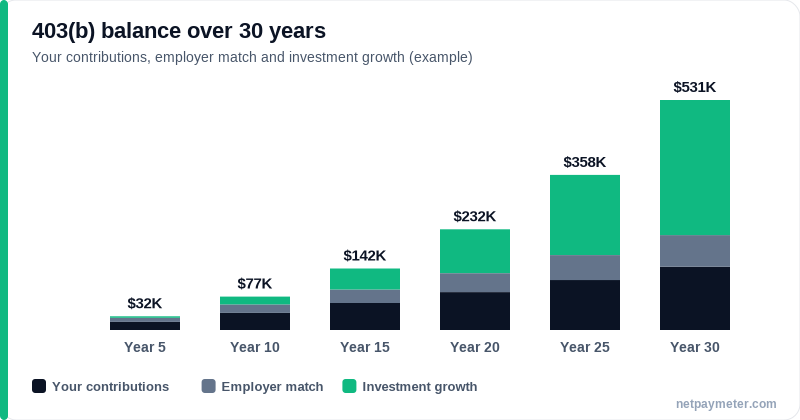
Starting from $0, $60,000 salary, 6% contribution, 50% match on up to 6%, 2% yearly raises:
| Years | 4% return | 6% return | 8% return |
|---|---|---|---|
| 10 | $70,537 | $77,200 | $84,594 |
| 20 | $190,397 | $232,360 | $285,751 |
| 30 | $386,650 | $530,837 | $742,617 |
| 40 | $700,105 | $1,090,487 | $1,756,483 |
Over 30 years you put in $146,045 and your employer adds $73,023; the rest is growth. Time and return make the biggest difference.
Get the full employer match
On a $50,000 salary, 30 years, 6% return, 2% raises, starting from $0:
| You contribute | Employer match | Projected balance |
|---|---|---|
| 5% | 100% up to 5% | $491,516 |
| 10% | 50% up to 6% | $638,971 |
If your plan matches, contributing at least up to the match cap is the simplest way to grow your savings: below it, you leave part of the match unclaimed.
403(b) vs. 401(k)
A 403(b) is the retirement plan offered by public schools, 501(c)(3) tax-exempt organizations and churches; a 401(k) is usually offered by for-profit companies. Both let you save from each paycheck before tax (or after tax in a Roth account, if offered), and both share the same $24,500 elective deferral limit for 2026. If you contribute to both in the same year, that limit applies to your combined deferrals.
Traditional 403(b) contributions lower the wages subject to federal income tax, but not Social Security and Medicare. See what a contribution does to your take-home pay with the paycheck calculator, and plan your withdrawals later with the retirement withdrawal calculator.
Sources
- IRS — Retirement topics: 403(b) contribution limits (2026 limits)
- IRS — Publication 571, Tax-Sheltered Annuity Plans (403(b) Plans)
- IRS — Retirement plans FAQs regarding 403(b) tax-sheltered annuity plans
This calculator gives estimates for information only and is not investment or tax advice.
Frequently asked questions
What is the 403(b) contribution limit for 2026?
$24,500 of elective deferrals (the money you put in from your pay), the same limit as a 401(k). Employees age 50 or older can add an $8,000 catch-up contribution if the plan allows it, or $11,250 at ages 60 to 63. Employer and employee contributions together are limited to the lesser of $72,000 or 100% of includible compensation.
How much will my 403(b) be worth when I retire?
It depends on your contributions, match, return and time. Starting from $0 on a $60,000 salary, contributing 6% with a 50% match on up to 6% of pay, a 6% yearly return and 2% yearly raises, a 403(b) grows to about $232,360 in 20 years and $530,837 in 30 years.
How does a 403(b) employer match work?
A common formula is "50% of what you contribute, up to 6% of salary". On a $60,000 salary, putting in 6% ($3,600) earns a $1,800 match. Contributing more than 6% raises your own savings, but the match stays at $1,800.
What is the difference between a 403(b) and a 401(k)?
They work much the same way and share the same $24,500 elective deferral limit for 2026. A 403(b) is offered by public schools, 501(c)(3) tax-exempt organizations and churches; a 401(k) is usually offered by for-profit employers.
Do 403(b) contributions lower my taxes?
Traditional (pre-tax) 403(b) contributions lower the wages subject to federal income tax in the year you make them, and withdrawals in retirement are taxed. Roth 403(b) contributions, if your plan offers them, are made after tax. See the effect on each paycheck with the paycheck calculator.