Effective Tax Rate Calculator
Your effective federal and total tax rate vs. your bracket. Free, updated for 2026 tax rates.
You changed your inputs. Press Calculate to update your results.
Use this free effective tax rate calculator to see what share of your salary really goes to tax in 2026: your effective federal income tax rate, your total effective rate including Social Security, Medicare and state tax, and your marginal tax bracket.
Quick answer: a single filer earning $75,000 pays $7,670 of federal income tax, an effective federal rate of 10.2%, even though they are in the 22% bracket. Adding $5,737.50 of Social Security and Medicare, the total effective rate is 17.9% in a state with no income tax.
How to use the effective tax rate calculator
- Enter your yearly salary and filing status.
- Pick your state to include state and local income tax and state payroll contributions (such as California SDI).
- Optional: add a 401(k) or 403(b) contribution and pre-tax health insurance.
- Read the result: your effective federal rate, your total effective rate, your tax bracket and the tax on your next $100 of pay.
Effective vs. marginal tax rate
| Rate | What it means | Formula | $75,000, single, 2026 |
|---|---|---|---|
| Marginal rate (tax bracket) | Rate on your last dollar of taxable income | Bracket your taxable income ends in | 22% |
| Effective federal rate | Share of your salary paid in federal income tax | federal income tax ÷ salary | $7,670 ÷ $75,000 = 10.2% |
| Effective total rate | Share of your salary paid in all taxes | (federal + FICA + state) ÷ salary | $13,407.50 ÷ $75,000 = 17.9% |
| Tax on your next $100 | What a raise or bonus actually costs in tax | change in total tax ÷ $100 | 22% + 7.65% = $29.65 |
Why your effective rate is lower than your bracket
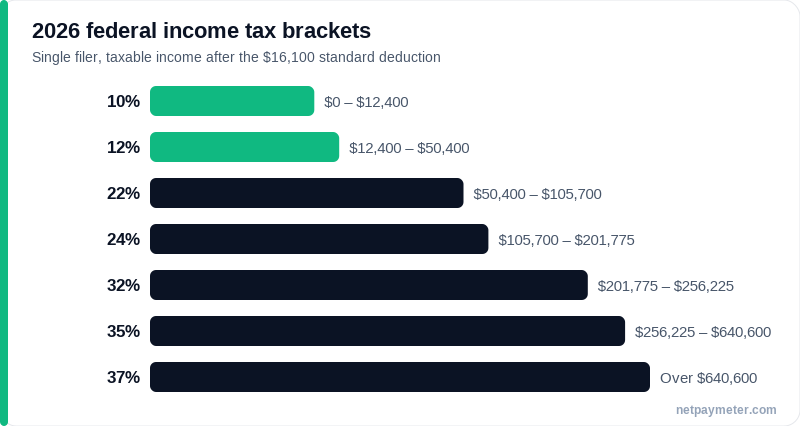
A single filer earning $75,000 subtracts the $16,100 standard deduction, leaving $58,900 of taxable income. The 2026 brackets then tax it in layers:
| Bracket | Taxable income in bracket | Tax |
|---|---|---|
| 10% | $12,400 | $1,240 |
| 12% | $38,000 | $4,560 |
| 22% | $8,500 | $1,870 |
| Total | $58,900 | $7,670 |
Only $8,500 is taxed at 22%. Divide the $7,670 by the full $75,000 salary and the effective federal rate is 10.2% (13.0% of taxable income).
Effective tax rates by salary (2026)
Single filer, standard deduction, no state income tax, no pre-tax deductions:
| Salary | Federal income tax | Effective federal rate | Total with FICA | Effective total rate | Tax bracket |
|---|---|---|---|---|---|
| $40,000 | $2,620 | 6.6% | $5,680 | 14.2% | 12% |
| $50,000 | $3,820 | 7.6% | $7,645 | 15.3% | 12% |
| $60,000 | $5,020 | 8.4% | $9,610 | 16.0% | 12% |
| $75,000 | $7,670 | 10.2% | $13,408 | 17.9% | 22% |
| $100,000 | $13,170 | 13.2% | $20,820 | 20.8% | 22% |
| $150,000 | $24,734 | 16.5% | $36,209 | 24.1% | 24% |
| $250,000 | $51,304 | 20.5% | $66,818 | 26.7% | 32% |
Married filing jointly, the wider brackets lower the rates: on $100,000 federal income tax is $7,640 (7.6% effective, 12% bracket); on $150,000 it is $15,340 (10.2% effective, 22% bracket).
State income tax raises the total
The same $75,000 single filer pays a total effective rate of 22.9% in California ($3,749.57 of state income tax and SDI) and 23.0% in New York ($3,808.20), compared with 17.9% in Texas or another state with no income tax. In California, the tax on the next $100 of pay is $38.95. See every state on the paycheck calculator.
How to lower your effective tax rate
- Pre-tax retirement contributions (401(k), 403(b)) lower the wages subject to federal income tax. Try a percentage in the calculator to see the effect.
- Pre-tax health insurance through payroll lowers federal income tax and Social Security and Medicare.
- Credits such as the child tax credit cut your tax dollar for dollar. This calculator doesn't include credits; use the federal income tax calculator to add them.
The same marginal-vs-effective logic applies to retirement withdrawals.
Sources
- IRS — Revenue Procedure 2025-32 (2026 tax brackets and standard deduction)
- Social Security Administration — 2026 contribution and benefit base
- Each state's department of revenue (see our methodology)
This calculator gives estimates for information only and is not tax advice.
Frequently asked questions
What is an effective tax rate?
The share of your income that actually goes to tax: total tax ÷ income. A single filer earning $75,000 in 2026 pays $7,670 of federal income tax, an effective federal rate of 10.2%, even though their tax bracket is 22%.
What is the difference between effective and marginal tax rate?
Your marginal rate (tax bracket) is the rate on your last, highest dollar of taxable income. Your effective rate is the average across all your income. Because the first dollars are taxed at 10% and 12%, and the standard deduction isn't taxed at all, your effective rate is always lower than your bracket.
What is the effective tax rate on $100,000?
For a single filer in 2026 with the standard deduction and no state income tax: $13,170 of federal income tax (13.2%) plus $7,650 of Social Security and Medicare, for a total effective rate of 20.8%. The federal bracket is 22%. Married filing jointly, federal income tax is $7,640 (7.6%).
Does a higher tax bracket mean all my income is taxed more?
No. Only the part of your taxable income above each bracket line is taxed at the higher rate. Moving into the 22% bracket raises the tax on those extra dollars only, so your effective rate rises slowly.
Which rate should I use for planning?
Use the effective rate to understand your overall tax burden and budget. Use the marginal rate, or the calculator's "tax on your next $100", to judge a raise, a bonus or a pre-tax contribution, because it shows how much of each extra dollar you keep.