Ohio Paycheck Calculator
Ohio has a flat 2.75% state income tax. See your 2026 take-home pay after federal, state and FICA taxes.
You changed your inputs. Press Calculate to update your results.
In Ohio, the state income tax is often the smaller tax on your paycheck: many cities charge more. This Ohio paycheck calculator applies the new 2026 flat 2.75% rate, the $26,050 tax-free zone and Ohio's income-based exemption, and lets you add your city tax rate.
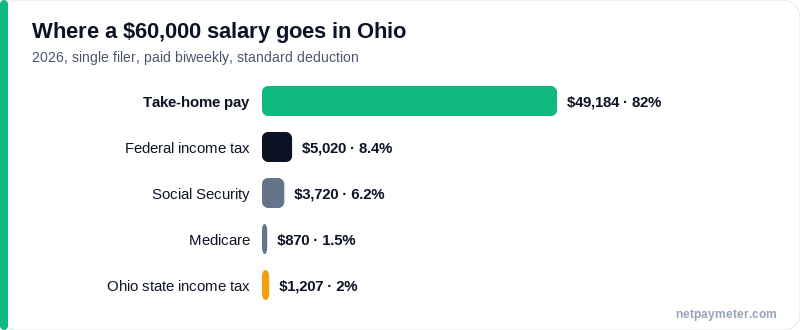
Quick answer: A single filer earning $60,000 in Ohio takes home about $49,184 a year, or $1,891.67 every two weeks, after $1,206.50 of Ohio income tax. That figure is before any city or school district income tax, which you can add under "More options".
How Ohio taxes your paycheck
Ohio moved to a flat 2.75% income tax in 2026 under HB 96. It works in three steps:
- Personal exemption. Subtract an exemption that depends on your income (see the table below).
- Tax-free zone. The first $26,050 of Ohio taxable income is taxed at 0%.
- Above $26,050: tax is a fixed $332 plus 2.75% of income over $26,050.
| Income (single) | Personal exemption |
|---|---|
| Up to $40,000 | $2,400 |
| $40,001 – $80,000 | $2,150 |
| $80,001 – $500,000 | $1,900 |
| Over $500,000 | $0 |
Married couples get double these amounts. Pre-tax 401(k) and health deductions lower Ohio taxable income too.
Worked example: $62,000 salary in Ohio
A single filer earns $62,000 a year, is paid every two weeks (26 paychecks), has no pre-tax deductions and lives where there is no city income tax.
- Federal taxable income: $62,000 − $16,100 = $45,900
- Federal income tax: 10% × $12,400 = $1,240, plus 12% × $33,500 = $4,020. Total $5,260.
- Ohio taxable income: $62,000 − $2,150 exemption = $59,850
- Ohio income tax: $332 + 2.75% × ($59,850 − $26,050) = $332 + $929.50 = $1,261.50
- Social Security 6.2% = $3,844 and Medicare 1.45% = $899
- Take-home pay: $62,000 − $5,260 − $3,844 − $899 − $1,261.50 = $50,735.50
| Item | Per paycheck (÷26) | Per month | Per year |
|---|---|---|---|
| Gross pay | $2,384.62 | $5,166.67 | $62,000.00 |
| Federal income tax | −$202.31 | −$438.33 | −$5,260.00 |
| Social Security | −$147.85 | −$320.33 | −$3,844.00 |
| Medicare | −$34.58 | −$74.92 | −$899.00 |
| Ohio income tax | −$48.52 | −$105.13 | −$1,261.50 |
| Take-home pay | $1,951.37 | $4,227.96 | $50,735.50 |
Amounts are rounded to the cent, so a column can be off by a penny. Before any city tax, this worker keeps about 81.8% of gross pay.
City income tax: often bigger than the state tax
This is what makes Ohio different. Most Ohio cities tax wages, usually at 1% to 2.5%. Columbus and Cleveland charge 2.5%. About 190 school districts add their own income tax on top.
Here is the same $62,000 worker at three common city rates:
| City tax rate | City tax per year | Yearly take-home | Per paycheck |
|---|---|---|---|
| None | $0 | $50,735.50 | $1,951.37 |
| 1% | $620 | $50,115.50 | $1,927.52 |
| 2% | $1,240 | $49,495.50 | $1,903.67 |
| 2.5% | $1,550 | $49,185.50 | $1,891.75 |
At 2.5%, the city takes $1,550, more than the $1,261.50 that goes to the state. The calculator above starts at 0% local tax, so enter your city rate under "More options". Your city or school district can tell you its exact rate.
Ohio tax at different salaries
Because of the tax-free zone, Ohio tax is low for lower earners and grows slowly. Single filers, no pre-tax deductions, no city tax:
| Salary | Exemption | Ohio taxable income | Ohio income tax |
|---|---|---|---|
| $28,000 | $2,400 | $25,600 | $0 |
| $40,000 | $2,400 | $37,600 | $649.63 |
| $45,000 | $2,150 | $42,850 | $794.00 |
| $62,000 | $2,150 | $59,850 | $1,261.50 |
| $85,000 | $1,900 | $83,100 | $1,900.88 |
| $100,000 | $1,900 | $98,100 | $2,313.38 |
A single worker earning $28,000 owes no Ohio income tax, but may still owe city tax.
What changed for 2026
- Flat 2.75% rate under HB 96, with the first $26,050 of taxable income tax-free.
- New withholding tables from August 2026. They may take a little more than you actually owe, so a small refund at filing time is possible.
Ohio hourly pay and minimum wage
Ohio's minimum wage is $11.00 an hour for larger employers and $7.25 for small businesses. At 40 hours a week, paid weekly, with no city tax, a single filer takes home about:
- $15 an hour: $516.18 a week
- $20 an hour: $671.25 a week
- $25 an hour: $826.45 a week ($42,975.50 a year)
Ohio vs nearby states
Pennsylvania, Indiana and Kentucky also have flat rates and local taxes. Michigan has a flat rate and city taxes in some cities, and West Virginia has graduated rates. The table below compares take-home pay on a $60,000 salary, before any local tax.
Sources
- IRS: Rev. Proc. 2025-32 (2026 federal brackets and standard deduction)
- Social Security Administration: 2026 wage base ($184,500)
- Ohio Legislative Service Commission: HB 96 tax greenbook (lsc.ohio.gov)
- U.S. Department of Labor and the Ohio labor department: minimum wage
Ohio salary after taxes (2026)
Estimated take-home pay for a single filer paid biweekly, with no pre-tax deductions. Total taxes are federal income tax, Ohio state tax, Social Security and Medicare (together called FICA).
| Salary | Total taxes | Take-home per year | Per paycheck |
|---|---|---|---|
| $30,000 | $4,090 | $25,910 | $996.55 |
| $50,000 | $8,577 | $41,424 | $1,593.21 |
| $60,000 | $10,817 | $49,184 | $1,891.67 |
| $75,000 | $15,027 | $59,974 | $2,306.67 |
| $100,000 | $23,133 | $76,867 | $2,956.41 |
| $150,000 | $39,897 | $110,103 | $4,234.72 |
On a $75,000 salary, Ohio ranks #12 of 51 (50 states and DC) for take-home pay. See where every state lands in our take-home pay by state ranking.
Ohio hourly wage after taxes
40 hours a week, single filer, paid weekly.
| Hourly wage | Gross per week | Take-home per week | Take-home per year |
|---|---|---|---|
| $15.00 | $600.00 | $516.18 | $26,842 |
| $20.00 | $800.00 | $671.25 | $34,905 |
| $25.00 | $1,000.00 | $826.45 | $42,976 |
| $30.00 | $1,200.00 | $981.65 | $51,046 |
| $40.00 | $1,600.00 | $1,259.80 | $65,510 |
Frequently asked questions
What is the Ohio income tax rate in 2026?
Ohio moved to a flat 2.75% income tax in 2026 under HB 96. The first $26,050 of Ohio taxable income is tax-free. Above that, you pay $332 plus 2.75% of income over $26,050, after a personal exemption of $2,400 to $1,900 that depends on your income.
How much is $60,000 a year after taxes in Ohio?
A single filer earning $60,000 in Ohio takes home about $49,184 a year in 2026, or $1,891.67 per biweekly paycheck. That is after federal income tax ($5,020), Social Security ($3,720), Medicare ($870) and Ohio income tax ($1,206.50), but before any city income tax.
How much is $62,000 a year after taxes in Ohio?
A single filer earning $62,000 in Ohio takes home about $50,736 a year, or $1,951.37 every two weeks, with no city tax. Ohio income tax is $1,261.50. In a city with a 2.5% income tax, take-home falls to about $49,186 a year, or $1,891.75 per paycheck.
Do Ohio cities charge income tax?
Yes. Most Ohio cities tax wages, usually at 1% to 2.5%. Columbus and Cleveland charge 2.5%. About 190 school districts also add their own income tax. On a $62,000 salary, a 2.5% city tax is $1,550 a year, more than the $1,261.50 Ohio state tax.
Do low earners pay Ohio income tax?
Often not. Ohio taxes nothing on the first $26,050 of taxable income, after a $2,400 exemption for single filers earning up to $40,000. A single worker earning $28,000 owes no Ohio income tax in 2026, though city income tax may still apply to their wages.
What is the minimum wage in Ohio?
Ohio's minimum wage is $11.00 an hour for larger employers and $7.25 an hour for small businesses. At 40 hours a week, a single filer earning $15 an hour in Ohio takes home about $516.18 a week, before any city income tax.
Other states
Pick your state to see its 2026 income tax, payroll deductions and example take-home pay.
Most searched: Texas paycheck calculator · California paycheck calculator · Florida paycheck calculator · Illinois paycheck calculator · New York paycheck calculator · Pennsylvania paycheck calculator
- Alabama
- Alaska
- Arizona
- Arkansas
- California
- Colorado
- Connecticut
- Delaware
- District of Columbia
- Florida
- Georgia
- Hawaii
- Idaho
- Illinois
- Indiana
- Iowa
- Kansas
- Kentucky
- Louisiana
- Maine
- Maryland
- Massachusetts
- Michigan
- Minnesota
- Mississippi
- Missouri
- Montana
- Nebraska
- Nevada
- New Hampshire
- New Jersey
- New Mexico
- New York
- North Carolina
- North Dakota
- Ohio
- Oklahoma
- Oregon
- Pennsylvania
- Rhode Island
- South Carolina
- South Dakota
- Tennessee
- Texas
- Utah
- Vermont
- Virginia
- Washington
- West Virginia
- Wisconsin
- Wyoming