Alaska Paycheck Calculator
Alaska has no state income tax on wages. See your 2026 take-home pay after federal income tax, Social Security and Medicare.
You changed your inputs. Press Calculate to update your results.
Alaska has no state income tax and no statewide sales tax, so a paycheck mostly loses only federal income tax, Social Security and Medicare. The one Alaska-only deduction is a small state unemployment insurance contribution paid by workers. Alaska's minimum wage rose to $14.00 an hour on July 1, 2026. This Alaska paycheck calculator shows what is left after the federal taxes.
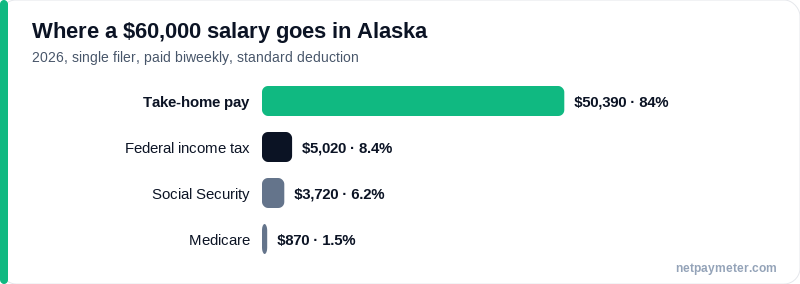
Quick answer: A single filer earning $60,000 in Alaska takes home about $50,390 a year, or $1,938.08 every two weeks, before the small unemployment insurance contribution.
How Alaska taxes your paycheck
Alaska has not had a personal income tax since 1980, and it has no statewide sales tax (some boroughs and cities charge local sales taxes on purchases). A typical Alaska paycheck has these deductions:
- Federal income tax, based on your Form W-4 and the 2026 federal brackets
- Social Security: 6.2% of wages, up to the 2026 wage base of $184,500
- Medicare: 1.45% of all wages, plus 0.9% above $200,000 (single)
- Alaska unemployment insurance (SUI): Alaska is one of only a few states where employees also pay into unemployment insurance. It is a small percentage of wages up to a yearly cap, and usually comes to well under $300 a year. This calculator leaves it out, so your stub may show a little less.
The Permanent Fund Dividend (PFD)
Most Alaska residents also receive a yearly Permanent Fund Dividend from the state's oil-wealth fund. The PFD is not part of your paycheck, but it is taxable on your federal return, so a large PFD can mean you owe a little more federal tax in April. If that's a concern, add some extra federal withholding with the W-4 calculator.
Worked example: $60,000 salary in Alaska
A single filer earns $60,000 a year, paid every two weeks, with no pre-tax deductions.
- Federal taxable income: $60,000 − $16,100 standard deduction = $43,900
- Federal income tax: 10% × $12,400 + 12% × $31,500 = $5,020
- Social Security: 6.2% × $60,000 = $3,720
- Medicare: 1.45% × $60,000 = $870
- Alaska income tax: $0
- Take-home pay: $60,000 − $5,020 − $3,720 − $870 = $50,390 (before the small SUI contribution)
| Item | Per paycheck (÷26) | Per month | Per year |
|---|---|---|---|
| Gross pay | $2,307.69 | $5,000.00 | $60,000.00 |
| Federal income tax | −$193.08 | −$418.33 | −$5,020.00 |
| Social Security | −$143.08 | −$310.00 | −$3,720.00 |
| Medicare | −$33.46 | −$72.50 | −$870.00 |
| Take-home pay | $1,938.08 | $4,199.17 | $50,390.00 |
Alaska take-home pay by salary (2026)
Single filer, paid biweekly, no pre-tax deductions, before SUI:
| Salary | Take-home per year | Per paycheck | Per month |
|---|---|---|---|
| $30,000 | $26,285.00 | $1,010.96 | $2,190.42 |
| $50,000 | $42,355.00 | $1,629.04 | $3,529.58 |
| $85,000 | $68,627.50 | $2,639.52 | $5,718.96 |
| $100,000 | $79,180.00 | $3,045.38 | $6,598.33 |
| $150,000 | $113,791.00 | $4,376.58 | $9,482.58 |
A married couple filing jointly on $100,000 takes home about $84,710; on $150,000, about $123,185.
Alaska minimum wage and hourly pay
Voters approved a series of minimum wage increases in 2024: Alaska's minimum is $14.00 an hour from July 1, 2026, rising to $15.00 on July 1, 2027. Full time at $14.00 (40 hours a week, paid weekly), a single filer takes home about $491.88 a week ($25,578 a year) after federal tax and FICA. Alaska also requires overtime after 8 hours in a day as well as after 40 in a week; use the overtime calculator to see what extra hours add.
Alaska vs other states
Alaska is one of nine states with no tax on wages, alongside Washington, Nevada, Texas, Wyoming, South Dakota, Tennessee, Florida and New Hampshire. Compared with Oregon, where a $60,000 earner keeps about $45,996, the same salary leaves about $4,394 more in Alaska. The table below compares take-home pay on a $60,000 salary.
Sources
- IRS: Rev. Proc. 2025-32 (2026 federal brackets and standard deduction)
- Alaska Department of Labor and Workforce Development: minimum wage, overtime and unemployment insurance
- Alaska Department of Revenue: Permanent Fund Dividend Division
Alaska salary after taxes (2026)
Estimated take-home pay for a single filer paid biweekly, with no pre-tax deductions. Total taxes are federal income tax, Social Security and Medicare (together called FICA).
| Salary | Total taxes | Take-home per year | Per paycheck |
|---|---|---|---|
| $30,000 | $3,715 | $26,285 | $1,010.96 |
| $50,000 | $7,645 | $42,355 | $1,629.04 |
| $60,000 | $9,610 | $50,390 | $1,938.08 |
| $75,000 | $13,408 | $61,593 | $2,368.94 |
| $100,000 | $20,820 | $79,180 | $3,045.38 |
| $150,000 | $36,209 | $113,791 | $4,376.58 |
On a $75,000 salary, Alaska ranks tied for #1 of 51 (50 states and DC) for take-home pay. See where every state lands in our take-home pay by state ranking. Alaska is one of the states with no income tax on wages.
Alaska hourly wage after taxes
40 hours a week, single filer, paid weekly.
| Hourly wage | Gross per week | Take-home per week | Take-home per year |
|---|---|---|---|
| $15.00 | $600.00 | $524.02 | $27,249 |
| $20.00 | $800.00 | $684.72 | $35,606 |
| $25.00 | $1,000.00 | $845.42 | $43,962 |
| $30.00 | $1,200.00 | $1,006.12 | $52,318 |
| $40.00 | $1,600.00 | $1,295.41 | $67,361 |
Compare Alaska with nearby states
Take-home pay on a $60,000 salary (single, biweekly):
| State | Take-home per year | Difference vs Alaska |
|---|---|---|
| Alaska | $50,390 | — |
| Washington | $49,558 | -$832 |
Frequently asked questions
Does Alaska have a state income tax?
No. Alaska has had no personal income tax since 1980 and has no statewide sales tax. A paycheck loses federal income tax, Social Security, Medicare and a small employee unemployment insurance contribution.
How much is $60,000 a year after taxes in Alaska?
A single filer earning $60,000 in Alaska takes home about $50,390 a year in 2026, or $1,938.08 per biweekly paycheck, after federal income tax ($5,020), Social Security ($3,720) and Medicare ($870), before the small unemployment insurance contribution.
Is the Alaska PFD taxable?
Yes, on your federal return. The Permanent Fund Dividend is not taxed by Alaska, but it counts as income for federal tax, so a large PFD can increase what you owe in April. Extra W-4 withholding can cover it.
What is the minimum wage in Alaska in 2026?
Alaska's minimum wage is $14.00 an hour from July 1, 2026, rising to $15.00 on July 1, 2027. Full time at $14.00, a single filer takes home about $492 a week after federal tax and FICA.
Does Alaska have daily overtime?
Yes. Alaska requires overtime pay at 1.5 times the regular rate for hours over 8 in a day, as well as for hours over 40 in a week, for most employers with four or more employees.
Other states
Pick your state to see its 2026 income tax, payroll deductions and example take-home pay.
Most searched: Texas paycheck calculator · California paycheck calculator · Florida paycheck calculator · Illinois paycheck calculator · New York paycheck calculator · Pennsylvania paycheck calculator
- Alabama
- Alaska
- Arizona
- Arkansas
- California
- Colorado
- Connecticut
- Delaware
- District of Columbia
- Florida
- Georgia
- Hawaii
- Idaho
- Illinois
- Indiana
- Iowa
- Kansas
- Kentucky
- Louisiana
- Maine
- Maryland
- Massachusetts
- Michigan
- Minnesota
- Mississippi
- Missouri
- Montana
- Nebraska
- Nevada
- New Hampshire
- New Jersey
- New Mexico
- New York
- North Carolina
- North Dakota
- Ohio
- Oklahoma
- Oregon
- Pennsylvania
- Rhode Island
- South Carolina
- South Dakota
- Tennessee
- Texas
- Utah
- Vermont
- Virginia
- Washington
- West Virginia
- Wisconsin
- Wyoming