Montana Paycheck Calculator
Montana taxes income at rates from 4.7% to 5.65%. See your 2026 take-home pay after federal, state and FICA taxes.
You changed your inputs. Press Calculate to update your results.
Montana taxes income at just two rates in 2026, 4.7% and 5.65%, and starts from your federal taxable income, so it uses the same standard deduction as your federal return. This Montana paycheck calculator applies the 2026 brackets on top of federal tax and FICA.
Quick answer: A single filer earning $60,000 in Montana takes home about $48,327 a year, or $1,858.72 every two weeks, after about $2,063 of Montana income tax.
How Montana taxes your paycheck
Since 2024 Montana has started from your federal taxable income: your wages minus pre-tax deductions and the federal standard deduction ($16,100 single, $32,200 married in 2026). Then two rates apply:
| Taxable income (single) | Taxable income (married) | Taxable income (head of household) | Rate |
|---|---|---|---|
| $0 – $47,500 | $0 – $95,000 | $0 – $71,250 | 4.7% |
| Over $47,500 | Over $95,000 | Over $71,250 | 5.65% |
House Bill 337 (2025) widened the 4.7% bracket and cut the top rate from 5.9%. Under the same law the top rate falls again, to 5.4% in 2027. Montana has no local income tax and no state sales tax.
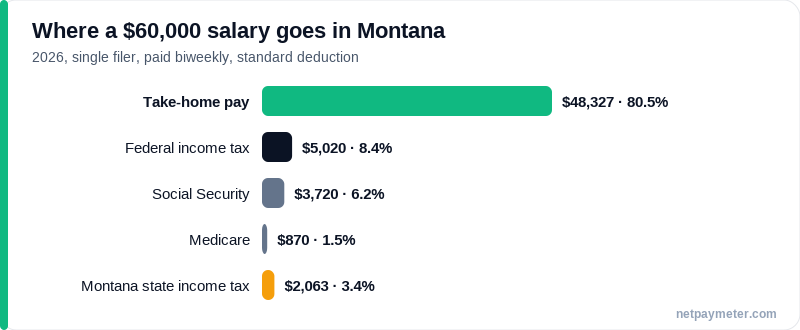
Worked example: $60,000 salary in Montana
A single filer earns $60,000 a year, paid every two weeks, with no pre-tax deductions.
- Federal taxable income: $60,000 − $16,100 = $43,900
- Montana income tax: 4.7% × $43,900 = $2,063.30 (all of it is in the 4.7% bracket)
- Federal income tax: $5,020
- Social Security $3,720 and Medicare $870
- Take-home pay: $60,000 − $5,020 − $3,720 − $870 − $2,063.30 = $48,326.70
| Item | Per paycheck (÷26) | Per month | Per year |
|---|---|---|---|
| Gross pay | $2,307.69 | $5,000.00 | $60,000.00 |
| Federal income tax | −$193.08 | −$418.33 | −$5,020.00 |
| Social Security | −$143.08 | −$310.00 | −$3,720.00 |
| Medicare | −$33.46 | −$72.50 | −$870.00 |
| Montana income tax | −$79.36 | −$171.94 | −$2,063.30 |
| Take-home pay | $1,858.72 | $4,027.23 | $48,326.70 |
This worker keeps about 80.5% of gross pay.
Montana take-home pay by salary (2026)
Single filer, paid biweekly, no pre-tax deductions:
| Salary | Montana income tax | Take-home per year | Per paycheck |
|---|---|---|---|
| $50,000 | $1,593.30 | $40,761.70 | $1,567.76 |
| $60,000 | $2,063.30 | $48,326.70 | $1,858.72 |
| $85,000 | $3,441.60 | $65,185.90 | $2,507.15 |
| $100,000 | $4,289.10 | $74,890.90 | $2,880.42 |
| $150,000 | $7,114.10 | $106,676.90 | $4,102.96 |
A single filer reaches the 5.65% rate once wages pass about $63,600 ($47,500 plus the standard deduction). A married couple filing jointly on $100,000 pays about $3,187 of Montana tax and takes home about $81,523; on $150,000, about $5,753 and $117,432.
Montana minimum wage and hourly pay
Montana's minimum wage is $10.85 an hour in 2026; it is adjusted for inflation every year. Full time at $10.85 (40 hours a week, paid weekly), a single filer takes home about $382.51 a week ($19,891 a year) after federal tax, FICA and about $304 of Montana tax. For overtime, use the hourly paycheck calculator.
Montana vs nearby states
Wyoming and South Dakota have no income tax, so a $60,000 salary keeps about $2,063 more there. North Dakota taxes the first $49,575 of taxable income at 0%, so a $60,000 earner there pays no state tax either. Idaho leaves about $48,318, almost the same as Montana. The table below compares take-home pay on a $60,000 salary.
Sources
- Montana Department of Revenue: HB 337 income tax changes
- IRS: Rev. Proc. 2025-32 (2026 federal brackets and standard deduction)
- Montana Department of Labor and Industry: minimum wage
Montana salary after taxes (2026)
Estimated take-home pay for a single filer paid biweekly, with no pre-tax deductions. Total taxes are federal income tax, Montana state tax, Social Security and Medicare (together called FICA).
| Salary | Total taxes | Take-home per year | Per paycheck |
|---|---|---|---|
| $30,000 | $4,368 | $25,632 | $985.83 |
| $50,000 | $9,238 | $40,762 | $1,567.76 |
| $60,000 | $11,673 | $48,327 | $1,858.72 |
| $75,000 | $16,284 | $58,716 | $2,258.30 |
| $100,000 | $25,109 | $74,891 | $2,880.42 |
| $150,000 | $43,323 | $106,677 | $4,102.96 |
On a $75,000 salary, Montana ranks #29 of 51 (50 states and DC) for take-home pay. See where every state lands in our take-home pay by state ranking. Bonuses are withheld differently from regular pay; the bonus tax calculator shows what you keep from one in Montana.
Montana hourly wage after taxes
40 hours a week, single filer, paid weekly.
| Hourly wage | Gross per week | Take-home per week | Take-home per year |
|---|---|---|---|
| $15.00 | $600.00 | $510.38 | $26,540 |
| $20.00 | $800.00 | $661.68 | $34,407 |
| $25.00 | $1,000.00 | $812.98 | $42,275 |
| $30.00 | $1,200.00 | $964.28 | $50,142 |
| $40.00 | $1,600.00 | $1,231.18 | $64,021 |
Frequently asked questions
What is the Montana income tax rate in 2026?
Montana has two income tax rates in 2026: 4.7% on the first $47,500 of taxable income for single filers ($95,000 married) and 5.65% above that. The top rate is scheduled to fall to 5.4% in 2027.
How much is $60,000 a year after taxes in Montana?
A single filer earning $60,000 in Montana takes home about $48,327 a year in 2026, or $1,858.72 per biweekly paycheck, after federal income tax ($5,020), Social Security ($3,720), Medicare ($870) and about $2,063 of Montana income tax.
Does Montana use the federal standard deduction?
Yes. Since 2024 Montana starts from your federal taxable income, so the federal standard deduction ($16,100 single, $32,200 married in 2026) is already taken out before Montana's rates apply.
Does Montana have local income taxes or a sales tax?
No. Montana cities and counties do not tax wages, and Montana has no statewide sales tax, though some resort areas charge local resort taxes on purchases.
What is the minimum wage in Montana in 2026?
Montana's minimum wage is $10.85 an hour in 2026. Full time at that rate, a single filer takes home about $383 a week after federal tax, FICA and Montana income tax.
Other states
Pick your state to see its 2026 income tax, payroll deductions and example take-home pay.
Most searched: Texas paycheck calculator · California paycheck calculator · Florida paycheck calculator · Illinois paycheck calculator · New York paycheck calculator · Pennsylvania paycheck calculator
- Alabama
- Alaska
- Arizona
- Arkansas
- California
- Colorado
- Connecticut
- Delaware
- District of Columbia
- Florida
- Georgia
- Hawaii
- Idaho
- Illinois
- Indiana
- Iowa
- Kansas
- Kentucky
- Louisiana
- Maine
- Maryland
- Massachusetts
- Michigan
- Minnesota
- Mississippi
- Missouri
- Montana
- Nebraska
- Nevada
- New Hampshire
- New Jersey
- New Mexico
- New York
- North Carolina
- North Dakota
- Ohio
- Oklahoma
- Oregon
- Pennsylvania
- Rhode Island
- South Carolina
- South Dakota
- Tennessee
- Texas
- Utah
- Vermont
- Virginia
- Washington
- West Virginia
- Wisconsin
- Wyoming