Colorado Paycheck Calculator
Colorado has a flat 4.4% state income tax. See your 2026 take-home pay after federal, state and FICA taxes.
You changed your inputs. Press Calculate to update your results.
Use this Colorado paycheck calculator to estimate your 2026 take-home pay. Enter a salary or an hourly wage and see every deduction on your check: federal income tax, Social Security, Medicare, Colorado state income tax and the Colorado FAMLI paid-leave premium.
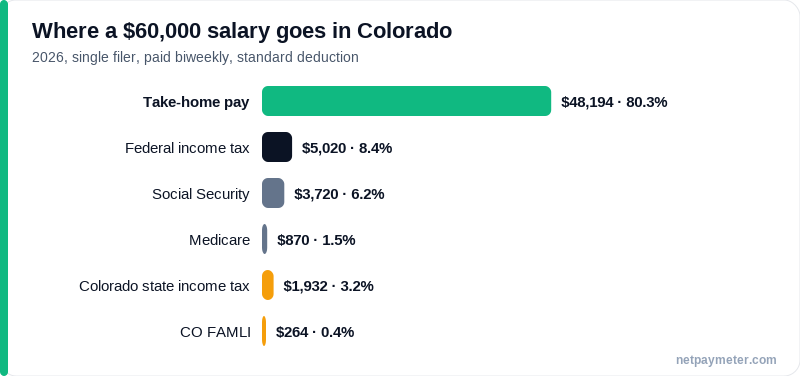
Quick answer: Colorado has a flat 4.4% income tax that starts from your federal taxable income, and most employees also pay 0.44% of wages for FAMLI. A single filer earning $60,000 takes home about $48,194 a year, or $1,853.63 every two weeks, after $1,931.60 of Colorado income tax and $264 of FAMLI.
How Colorado taxes your paycheck
Colorado keeps it simple: one flat rate of 4.4% for every filer. What makes Colorado different is the starting point. Instead of using its own deductions, Colorado starts from your federal taxable income, which is your pay after pre-tax deductions and the federal standard deduction ($16,100 single, $32,200 married filing jointly, $24,150 head of household in 2026).
That means anything that lowers your federal taxable income, such as a 401(k) contribution, also lowers your Colorado tax by 4.4% of that amount.
Your Colorado paycheck has five main deductions:
| Deduction | 2026 rate | Notes |
|---|---|---|
| Federal income tax | 10% – 37% | After the $16,100 standard deduction (single) |
| Social Security | 6.2% | Wages up to $184,500 |
| Medicare | 1.45% | +0.9% above $200,000 (single) |
| Colorado income tax | 4.4% flat | Of federal taxable income |
| CO FAMLI premium | 0.44% | Wages up to $184,500 |
What is FAMLI on a Colorado paycheck?
FAMLI is Colorado's paid family and medical leave program. Employees pay half of the premium. This calculator uses 0.44% of wages in 2026, assuming a 0.88% total premium, applied to wages up to $184,500. On a $60,000 salary that is $264 a year. It shows on your pay stub as a separate line from Colorado income tax.
Worked example: $75,000 salary in Colorado
A single filer earns $75,000 a year, is paid every two weeks (26 paychecks) and has no pre-tax deductions.
- Federal taxable income: $75,000 − $16,100 = $58,900
- Federal income tax: 10% × $12,400 = $1,240, plus 12% × $38,000 = $4,560, plus 22% × $8,500 = $1,870. Total $7,670.
- Colorado income tax: 4.4% × $58,900 = $2,591.60
- FAMLI: 0.44% × $75,000 = $330
- Social Security $4,650 and Medicare $1,087.50
| Item | Per paycheck (÷26) | Per month | Per year |
|---|---|---|---|
| Gross pay | $2,884.62 | $6,250.00 | $75,000.00 |
| Federal income tax | −$295.00 | −$639.17 | −$7,670.00 |
| Social Security | −$178.85 | −$387.50 | −$4,650.00 |
| Medicare | −$41.83 | −$90.63 | −$1,087.50 |
| Colorado income tax | −$99.68 | −$215.97 | −$2,591.60 |
| CO FAMLI | −$12.69 | −$27.50 | −$330.00 |
| Take-home pay | $2,256.57 | $4,889.24 | $58,670.90 |
Amounts are rounded to the cent. This worker keeps about 78.2% of gross pay.
Local taxes: Colorado's Occupational Privilege Taxes
Colorado cities don't charge a percentage income tax, but a few charge a small Occupational Privilege Tax (OPT) on people who work there: Denver, Aurora, Glendale, Greenwood Village and Sheridan. It's a fixed monthly amount, not a percentage. In Denver, for example, it is $5.75 a month.
Because OPT is a flat dollar amount, don't enter it as a local tax rate in the calculator. Subtract it from your take-home pay instead.
What changed for 2026
- FAMLI: the employee share used here is 0.44% of wages up to $184,500 in 2026.
- Bigger federal standard deduction: $16,100 for single filers, up from $15,750 in 2025. Because Colorado starts from federal taxable income, this also trims your Colorado tax.
- Higher Social Security wage base: $184,500, up from $176,100 in 2025.
Pay frequency: how your check changes
On a $60,000 salary in Colorado (single, no deductions), yearly take-home is $48,194.40 whatever the schedule:
| Pay schedule | Paychecks a year | Take-home per paycheck |
|---|---|---|
| Weekly | 52 | $926.82 |
| Every two weeks | 26 | $1,853.63 |
| Twice a month | 24 | $2,008.10 |
| Monthly | 12 | $4,016.20 |
Twice-a-month checks are larger than biweekly ones, but you get two fewer of them each year.
Colorado hourly pay after taxes
At 40 hours a week, paid weekly, a single filer takes home about:
- $15 an hour: $508.61 a week
- $20 an hour: $659.63 a week
- $25 an hour: $810.65 a week ($42,153.60 a year)
For shift work and overtime, use the hourly paycheck calculator and the overtime calculator.
Comparing Colorado with nearby states
Thinking about a move? Wyoming has no state income tax, and Utah also uses a flat rate. The comparison table below shows take-home pay on the same $60,000 salary. To compare offers by hourly, weekly or monthly pay, try the salary calculator.
Sources
- IRS: Rev. Proc. 2025-32 (2026 federal brackets and standard deduction)
- Social Security Administration: 2026 wage base ($184,500)
- Colorado Department of Revenue: 4.4% income tax rate based on federal taxable income
- Colorado FAMLI program: premium rate and employee share
Colorado salary after taxes (2026)
Estimated take-home pay for a single filer paid biweekly, with no pre-tax deductions. Total taxes are federal income tax, Colorado state tax, Social Security and Medicare (together called FICA), plus state payroll deductions.
| Salary | Total taxes | Take-home per year | Per paycheck |
|---|---|---|---|
| $30,000 | $4,459 | $25,541 | $982.36 |
| $50,000 | $9,357 | $40,643 | $1,563.21 |
| $60,000 | $11,806 | $48,194 | $1,853.63 |
| $75,000 | $16,329 | $58,671 | $2,256.57 |
| $100,000 | $24,952 | $75,048 | $2,886.48 |
| $150,000 | $42,761 | $107,239 | $4,124.59 |
On a $75,000 salary, Colorado ranks #30 of 51 (50 states and DC) for take-home pay. See where every state lands in our take-home pay by state ranking.
Colorado hourly wage after taxes
40 hours a week, single filer, paid weekly.
| Hourly wage | Gross per week | Take-home per week | Take-home per year |
|---|---|---|---|
| $15.00 | $600.00 | $508.61 | $26,448 |
| $20.00 | $800.00 | $659.63 | $34,301 |
| $25.00 | $1,000.00 | $810.65 | $42,154 |
| $30.00 | $1,200.00 | $961.67 | $50,007 |
| $40.00 | $1,600.00 | $1,231.59 | $64,043 |
Frequently asked questions
What is the Colorado state income tax rate in 2026?
Colorado has a flat 4.4% income tax. It applies to your federal taxable income, so the federal standard deduction ($16,100 single in 2026) and pre-tax 401(k) contributions lower your Colorado tax too.
How much is $60,000 a year after taxes in Colorado?
A single filer earning $60,000 in Colorado takes home about $48,194 a year in 2026, or $1,853.63 per biweekly paycheck. That's after federal income tax ($5,020), Social Security ($3,720), Medicare ($870), Colorado income tax ($1,931.60) and FAMLI ($264).
How much is $75,000 a year after taxes in Colorado?
About $58,671 a year for a single filer, or $2,256.57 every two weeks. Colorado income tax is $2,591.60 and the FAMLI premium is $330.
What is FAMLI on my Colorado paycheck?
FAMLI is Colorado's paid family and medical leave premium. Employees pay half of it. This calculator uses 0.44% of wages up to $184,500 for 2026, assuming a 0.88% total premium.
Do Colorado cities have a local income tax?
Not a percentage income tax. Denver, Aurora, Glendale, Greenwood Village and Sheridan charge a small monthly Occupational Privilege Tax on people who work there, for example $5.75 a month in Denver.
How much is $25 an hour after taxes in Colorado?
At 40 hours a week, a single filer earning $25 an hour in Colorado takes home about $810.65 a week, or $42,153.60 a year.
Other states
Pick your state to see its 2026 income tax, payroll deductions and example take-home pay.
Most searched: Texas paycheck calculator · California paycheck calculator · Florida paycheck calculator · Illinois paycheck calculator · New York paycheck calculator · Pennsylvania paycheck calculator
- Alabama
- Alaska
- Arizona
- Arkansas
- California
- Colorado
- Connecticut
- Delaware
- District of Columbia
- Florida
- Georgia
- Hawaii
- Idaho
- Illinois
- Indiana
- Iowa
- Kansas
- Kentucky
- Louisiana
- Maine
- Maryland
- Massachusetts
- Michigan
- Minnesota
- Mississippi
- Missouri
- Montana
- Nebraska
- Nevada
- New Hampshire
- New Jersey
- New Mexico
- New York
- North Carolina
- North Dakota
- Ohio
- Oklahoma
- Oregon
- Pennsylvania
- Rhode Island
- South Carolina
- South Dakota
- Tennessee
- Texas
- Utah
- Vermont
- Virginia
- Washington
- West Virginia
- Wisconsin
- Wyoming