North Carolina Paycheck Calculator
North Carolina has a flat 3.99% state income tax. See your 2026 take-home pay after federal, state and FICA taxes.
You changed your inputs. Press Calculate to update your results.
North Carolina keeps its income tax simple: one rate for everyone, no brackets and no city taxes. This North Carolina paycheck calculator shows your 2026 take-home pay after federal income tax, Social Security, Medicare and the state's 3.99% tax, for salaried or hourly jobs.
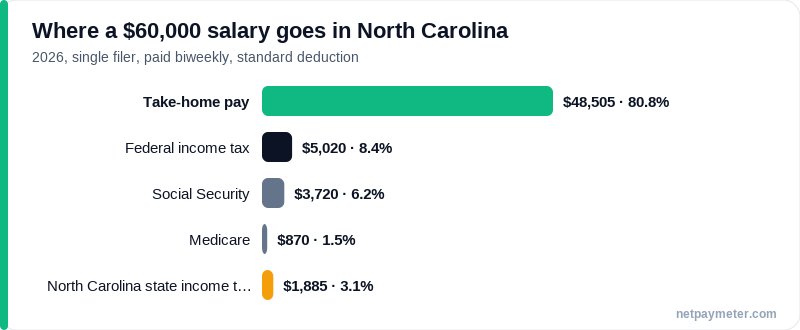
Quick answer: A single filer earning $60,000 in North Carolina takes home about $48,505 a year, or $1,865.57 every two weeks. That is after $1,885.28 of North Carolina income tax, figured on $47,250 of state taxable income.
How North Carolina taxes your paycheck
North Carolina has one flat rate: 3.99% in 2026. There are no brackets. You subtract the North Carolina standard deduction from your wages, and the rest is taxed at 3.99%.
The catch is the deduction. North Carolina's standard deduction is smaller than the federal one, so more of your pay is taxed by the state than by the IRS.
| Filing status | NC standard deduction | Federal standard deduction |
|---|---|---|
| Single | $12,750 | $16,100 |
| Married filing jointly | $25,500 | $32,200 |
| Head of household | $19,125 | $24,150 |
Worked example: $48,000 salary in North Carolina
A single filer earns $48,000 a year, is paid every two weeks (26 paychecks) and has no pre-tax deductions.
- Federal taxable income: $48,000 − $16,100 = $31,900
- Federal income tax: 10% × $12,400 = $1,240, plus 12% × $19,500 = $2,340. Total $3,580.
- North Carolina taxable income: $48,000 − $12,750 = $35,250. That is $3,350 more than the federal figure.
- North Carolina income tax: 3.99% × $35,250 = $1,406.475, or $1,406.48
- Social Security 6.2% = $2,976 and Medicare 1.45% = $696
- Take-home pay: $48,000 − $3,580 − $2,976 − $696 − $1,406.475 = $39,341.53
| Item | Per paycheck (÷26) | Per month | Per year |
|---|---|---|---|
| Gross pay | $1,846.15 | $4,000.00 | $48,000.00 |
| Federal income tax | −$137.69 | −$298.33 | −$3,580.00 |
| Social Security | −$114.46 | −$248.00 | −$2,976.00 |
| Medicare | −$26.77 | −$58.00 | −$696.00 |
| North Carolina income tax | −$54.10 | −$117.21 | −$1,406.48 |
| Take-home pay | $1,513.14 | $3,278.46 | $39,341.53 |
Amounts are rounded to the cent, so a column can be off by a penny. This worker keeps about 82% of gross pay.
What changed for 2026
North Carolina cut its flat rate to 3.99% for 2026, down from 4.25% in 2025. Nothing else about the method changed: one rate, one standard deduction, no local tax. All figures on this page use the 2026 rate.
Filing status changes the state bill
Because North Carolina's deduction doubles for married couples, filing status makes a real difference even at one rate. Here is the same $48,000 salary under each status (biweekly, no pre-tax deductions):
| Filing status | NC taxable income | NC income tax | Yearly take-home |
|---|---|---|---|
| Single | $35,250 | $1,406.48 | $39,341.53 |
| Head of household | $28,875 | $1,152.11 | $40,667.89 |
| Married filing jointly | $22,500 | $897.75 | $41,850.25 |
The take-home column also reflects the lower federal tax for each status.
A 401(k) cuts North Carolina tax too
Pre-tax 401(k) savings come off your wages before the 3.99% is applied. If the $48,000 worker above saves 5% ($2,400) in a 401(k):
- North Carolina taxable income falls to $32,850
- North Carolina income tax falls from $1,406.48 to $1,310.72
- Federal income tax falls from $3,580 to $3,292
- Take-home pay is $37,325.29 a year, or $1,435.59 every two weeks
So the $2,400 you save does not cost you $2,400 in take-home pay. Lower federal and state tax cover part of it.
No city or county income tax
North Carolina has no local income taxes. Living in a big city or a small town makes no difference to your paycheck. Leave the local tax field in the calculator at 0%.
North Carolina hourly pay and minimum wage
North Carolina uses the federal minimum wage of $7.25 an hour. At 40 hours a week, paid weekly, a single filer takes home about:
- $15 an hour: $509.87 a week
- $20 an hour: $662.59 a week
- $25 an hour: $815.31 a week ($42,395.93 a year)
For overtime and variable hours, use the hourly paycheck calculator or the overtime calculator.
North Carolina vs nearby states
Tennessee has no state income tax on wages. Virginia and South Carolina use graduated rates, and Georgia has a flat rate like North Carolina. The table below shows take-home pay on the same $60,000 salary. To check your federal withholding, try the W-4 calculator.
Sources
- IRS: Rev. Proc. 2025-32 (2026 federal brackets and standard deduction)
- Social Security Administration: 2026 wage base ($184,500)
- North Carolina Department of Revenue: 2026 income tax rate and standard deduction
- U.S. Department of Labor: federal minimum wage
North Carolina salary after taxes (2026)
Estimated take-home pay for a single filer paid biweekly, with no pre-tax deductions. Total taxes are federal income tax, North Carolina state tax, Social Security and Medicare (together called FICA).
| Salary | Total taxes | Take-home per year | Per paycheck |
|---|---|---|---|
| $30,000 | $4,403 | $25,597 | $984.49 |
| $50,000 | $9,131 | $40,869 | $1,571.87 |
| $60,000 | $11,495 | $48,505 | $1,865.57 |
| $75,000 | $15,891 | $59,109 | $2,273.41 |
| $100,000 | $24,301 | $75,699 | $2,911.49 |
| $150,000 | $41,685 | $108,315 | $4,165.95 |
On a $75,000 salary, North Carolina ranks #20 of 51 (50 states and DC) for take-home pay. See where every state lands in our take-home pay by state ranking.
North Carolina hourly wage after taxes
40 hours a week, single filer, paid weekly.
| Hourly wage | Gross per week | Take-home per week | Take-home per year |
|---|---|---|---|
| $15.00 | $600.00 | $509.87 | $26,513 |
| $20.00 | $800.00 | $662.59 | $34,454 |
| $25.00 | $1,000.00 | $815.31 | $42,396 |
| $30.00 | $1,200.00 | $968.03 | $50,337 |
| $40.00 | $1,600.00 | $1,241.35 | $64,550 |
Frequently asked questions
What is the North Carolina income tax rate in 2026?
North Carolina has a flat 3.99% income tax rate in 2026, down from 4.25% in 2025. Everyone pays the same rate on wages above the state standard deduction, which is $12,750 for single filers, $19,125 for heads of household and $25,500 for married couples filing jointly.
How much is $60,000 a year after taxes in North Carolina?
A single filer earning $60,000 in North Carolina takes home about $48,505 a year in 2026, or $1,865.57 per biweekly paycheck. That is after federal income tax ($5,020), Social Security ($3,720), Medicare ($870) and North Carolina income tax ($1,885.28).
How much is $48,000 a year after taxes in North Carolina?
A single filer earning $48,000 in North Carolina takes home about $39,342 a year, or $1,513.14 every two weeks. North Carolina income tax is $1,406.48, which is 3.99% of $35,250 of state taxable income after the $12,750 standard deduction.
Why is my North Carolina taxable income higher than my federal taxable income?
North Carolina's standard deduction is smaller than the federal one. A single filer subtracts $12,750 for North Carolina but $16,100 for federal tax in 2026. So the state taxes about $3,350 more of your pay than the IRS does, before applying its 3.99% rate.
Do North Carolina cities charge a local income tax?
No. North Carolina has no city or county income taxes, so your paycheck only shows federal income tax, Social Security, Medicare and the 3.99% state income tax. Where you live or work inside North Carolina does not change your withholding.
What is the minimum wage in North Carolina?
North Carolina uses the federal minimum wage of $7.25 an hour. At 40 hours a week, a single filer earning $15 an hour in North Carolina takes home about $509.87 a week after federal tax, FICA and the 3.99% state income tax.
Other states
Pick your state to see its 2026 income tax, payroll deductions and example take-home pay.
Most searched: Texas paycheck calculator · California paycheck calculator · Florida paycheck calculator · Illinois paycheck calculator · New York paycheck calculator · Pennsylvania paycheck calculator
- Alabama
- Alaska
- Arizona
- Arkansas
- California
- Colorado
- Connecticut
- Delaware
- District of Columbia
- Florida
- Georgia
- Hawaii
- Idaho
- Illinois
- Indiana
- Iowa
- Kansas
- Kentucky
- Louisiana
- Maine
- Maryland
- Massachusetts
- Michigan
- Minnesota
- Mississippi
- Missouri
- Montana
- Nebraska
- Nevada
- New Hampshire
- New Jersey
- New Mexico
- New York
- North Carolina
- North Dakota
- Ohio
- Oklahoma
- Oregon
- Pennsylvania
- Rhode Island
- South Carolina
- South Dakota
- Tennessee
- Texas
- Utah
- Vermont
- Virginia
- Washington
- West Virginia
- Wisconsin
- Wyoming